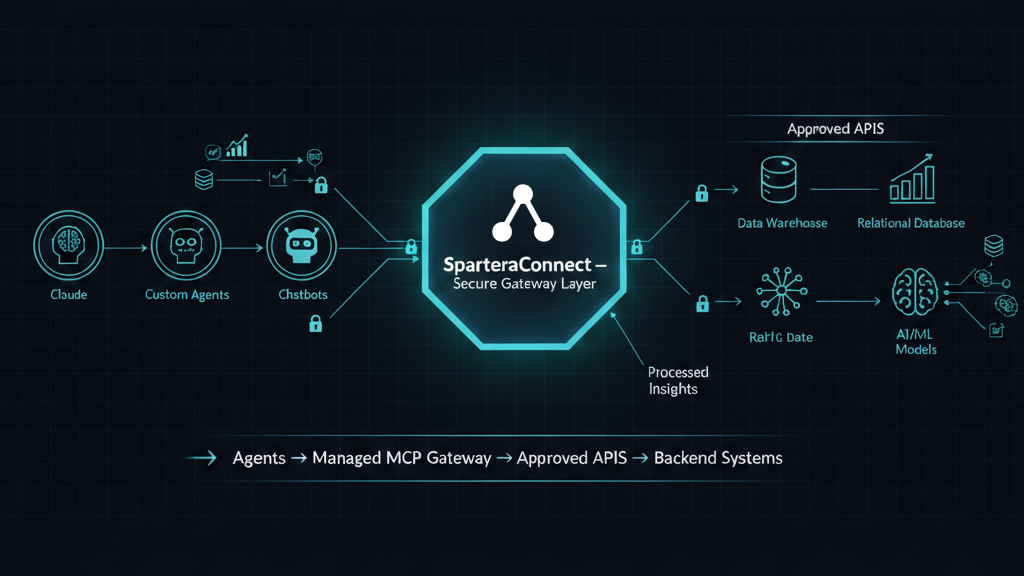
From Warehouse Table to Priced Product, Without Leaving the Conversation
MIT's decade of research found top performers attribute 11% of revenue to data monetization and bottom performers 2%. The gap was never a data problem — it was a workflow problem. Your registrations table can't be sold; the EV-adoption index inside it can. Getting from one to the other meant a SQL client, a BI tool, a spreadsheet, a pricing debate and an admin console. Spartera's MCP connector collapses that into a single conversation — Spartera never stores the raw data, just the logic, and no records are ever transferred.
The Bottleneck Was Never the Data
Ask a data owner why more of their data isn't earning money and you will almost never hear "we don't have anything worth selling." You will hear some version of: we know exactly what we'd sell, we just haven't gotten to it.
That answer is worth taking seriously, because it points somewhere specific. The asset exists. The buyer demand is often known. What's missing is the string of steps between the two — and those steps have always been expensive out of proportion to their difficulty.
Consider what it actually took, until now, to turn one warehouse table into one listed product. Open a SQL client and explore the schema. Write and refine the query. Move the result into a BI tool or a notebook to see whether the shape is right. Decide what the thing should be called and what it measures. Argue about a price with no reference point. Log into an admin console and re-enter all of it by hand. Somewhere in there, wait on the one analyst who can write the query.
None of those steps is hard. Together they are a multi-week errand that competes with every other thing that analyst could be doing — which is precisely why it keeps losing. The work isn't blocked. It's just never first.
MIT CISR's decade of data monetization research put a number on what that costs: top performers attribute 11% of revenue to data monetization, bottom performers 2%. The gap isn't explained by data volume or industry. It's explained by capability — by whether an organization can reliably get from we could sell this to this is listed and earning.
The Spartera MCP connector is our answer to that specific gap. It puts the entire authoring loop inside a conversation with Claude.
The Authoring Tax

Every context switch in that workflow costs more than the minutes it consumes. It costs the thread of what you were doing.
The exploration tax. Before you can build anything, you have to know what's in the warehouse. Which tables, which columns, how many rows are actually populated. That reconnaissance almost always requires someone with warehouse credentials and SQL fluency — which means the business person with the product idea and the technical person who can check it are two different people having a scheduled conversation.
The shaping tax. A query result is not a product. Turning one into the other means deciding what it measures, what units it reports in, what caveats a buyer needs, and whether the number is even the right number. That judgment sits with the person who understands the business, who is usually not the person running the query.
The pricing tax. This is the step that stalls things longest, because it has no obvious answer and no obvious owner. Price it too high and it never sells. Too low and you've anchored your own market. Most teams resolve this by not resolving it, and the draft sits.
The re-entry tax. Once every decision is made, someone re-types it all into an admin interface — name, description, SQL, units, price. Pure transcription, and a fresh opportunity for the thing that was carefully validated in one tool to arrive subtly wrong in another.
Add it up and the cost of publishing your second data product is nearly identical to the cost of your first. Nothing compounds. That's the signature of a workflow problem rather than a data problem — and workflow problems are exactly what conversational interfaces are good at dissolving.
The Whole Loop, In One Place
Connect your Spartera MCP server to Claude and thirteen tools become available in the conversation. Six of them are the buyer-side tools we shipped first — discovering and running analytics. The seven that matter here are the ones that let you build and sell.
The shape of the change is simple to state: every step of the authoring loop now happens in the same place, with the same context, without anyone re-typing anything.
You can ask what's in your warehouse and get an answer. You can ask for a query and see the rows before committing to anything. You can turn those rows into a Spartera asset — a single-value calculation or a chart — and the SQL you just validated is what gets stored. You can read the draft back to confirm what was saved. You can ask what's holding it back from ranking well. You can ask what it should cost. And when you're ready, you can publish it to the marketplace.
Notice what is not in that list. No data export. No file moved anywhere. No credentials handed to a third party. The asset that gets created is SQL logic plus metadata bound to your connection — the analytic runs against your warehouse at query time, exactly as it did before. This is the same architecture behind SparteraConnect: the analytic travels, the data stays.
Sign-in is your Spartera account through OAuth. There's no API key to generate, paste, or rotate, and no separate credential for a colleague to request. Your role comes with you — which matters more than it sounds, and we'll come back to it.
What It Looks Like: One Registrations Table
Take a data business that already licenses its files — a vehicle-registration provider, say. NEW_REGISTRATIONS holds one row per new vehicle: VIN, owner name, garaging address, powertrain, metro. It's genuinely valuable, and it moves today under negotiated contracts with real compliance overhead on both sides.
It also cannot be sold as-is on a marketplace. Owner names, addresses and VINs are personal data. That's not a policy preference — Spartera blocks it at publish.
But the answer sitting inside that table is a different object entirely. EV share of new registrations by metro is a few dozen rows with no person in it, and it's exactly what an OEM planning capacity, a charging network siting stations, or an insurer repricing a book would pay for. Same proprietary data, new product, none of the disclosure risk.
That's the shift worth noticing. This isn't a company finding something new to sell — it's a company that already monetizes data creating a second, safer SKU from the asset it has. In the old workflow that meant an analyst, a query, an export, a review and a pricing conversation. In the conversation it's one exchange.
And the sample rows show you the problem before you build on it. The PII is right there in the first result set, which is the moment you want to see it — not after you've defined a product around it.
We hit the same phenomenon on a live warehouse while building the connector. Asked for arena capacity by team, and the returned rows made it obvious that fourteen of thirty were null — while a metric already published in the catalog was averaging the sixteen that weren't and presenting the result as a league figure. It had been wrong for as long as it had existed, and it surfaced in one exchange because the rows and the product definition were finally in the same window.
Walk the Loop Yourself
Reading about a workflow is a poor substitute for watching one. Below is the sequence on a vehicle-registration table — the sample rows that stop you from selling them, the pivot to an answer you can, formatting the chart, overriding the suggested price, and the approval gate at the end.
Step through it at your own pace. The amber tools are the ones that write.
The authoring loop, one step at a time
One vehicle-registration table — from rows you could never sell to an answer you can, without the data leaving your warehouse.
Why Answers, and Not Rows
This is the part that matters more than any tool in the list, and it's worth being explicit about because it's the whole reason the authoring surface is shaped the way it is.
Spartera never stores the raw data, just the logic. When you save a calculation or a visualization, what gets written is SQL bound to your connection plus its metadata. No export runs. Nothing is staged, copied or warehoused on our side. Every buyer request re-executes that query against your systems.
And no records are ever transferred. This is the piece people assume must have an asterisk, and it doesn't. A buyer of a visualization receives a rendered image — an SVG or PNG of the chart. A buyer of a calculation receives a single value, text or scalar. Neither receives a row. The distinction between a data sale and an answer sale isn't contractual here; it's structural.
Four things follow, and each is a problem raw data sharing has never solved.
You can sell what you could never ship. The registrations table is unsellable. The aggregate over it is not. Answers are how regulated and personally identifying data becomes monetizable without ever being disclosed — and the marketplace re-runs its safety and PII checks at publish, so a query that would still expose a person is refused.
A sale stays revocable. A delivered file is gone. You cannot un-sell it, meter it, or stop the buyer's third copy. A metered answer can be priced per request, revoked, versioned and repriced — a product with a lifecycle rather than a one-time transfer.
Buyers get freshness for free. There's no pipeline to keep in sync, because there's no pipeline. The answer computed on a buyer's Tuesday request is as current as your warehouse was on Tuesday.
And the economics are better. A raw dataset competes on volume and price. A processed answer competes on judgment — the filters you knew to apply, the caveat you knew to state. That's what a buyer can't replicate by acquiring more rows, and it's why intelligence prices above information.
This has been our argument since the first thing we ever published. What's new isn't the thesis. It's that producing one of those answers no longer requires leaving the conversation you're already in.
Why "In the Conversation" Changes the Economics
Three things change once the loop closes, and only one of them is speed.
The analyst stops being a bottleneck and starts being a reviewer. The person with the product idea can explore the warehouse, see real rows, and shape a draft themselves. The analyst's expertise gets spent on whether the logic is right rather than on translating a request into SQL. That's a better use of the scarcest person in the building.
Pricing stops being a stall. A suggested price based on the asset's type, content, and comparable listings won't always be the number you go with — but it converts an open-ended debate into a reaction. Reacting to a number is a decision people make in a minute. Producing one from nothing is a decision people postpone for a month.
Quality gets designed in rather than audited later. Asking what's missing before publishing is a different act from discovering after launch that your best-selling metric has no description. The recommendation surface exists in the API already; putting it in the authoring conversation is what makes it get used.
Underneath all three is the same mechanic MIT identified as separating the 11% from the 2%: value doesn't realize itself. A benefit becomes revenue only when someone acts to convert it. Every hour of friction between an idea and a listing is an hour in which the conversion doesn't happen — and, more often, never happens at all. Removing that friction isn't a convenience feature. It's the difference between a data strategy that compounds and one that produces a single impressive pilot.
Autonomy With a Hand on the Brake
Putting write access into a conversational agent raises an obvious question, and it deserves a direct answer rather than a reassurance.
Publishing always asks. The tool that lists an asset on the marketplace and sets its price requires explicit confirmation every time. It is never inferred from context, never bundled into a broader request, and never executed on a price the agent chose. An agent can prepare everything up to that line; a human crosses it.
Your role travels with you. Because sign-in is OAuth against your Spartera account, the connector inherits your permissions rather than granting a shared level of access. Buyer-role users see the read tools only — the tools that create, modify, or publish assets are not merely disabled for them, they aren't listed. A credential that shouldn't be able to publish never sees a publish tool.
Drafts are private by default. Anything created through the connector lands unlisted and not for sale. Publishing is a separate, deliberate act, which means the exploratory work of building and discarding several versions carries no risk of something half-finished appearing on the marketplace.
Marketplace checks still apply. The safety and PII validation that runs when an asset goes on sale is stricter than what runs on a draft. A draft that saved cleanly can still be refused at publish time — and that refusal is the system working, not a bug to route around.
The Full Tool Reference
Thirteen tools, grouped by what they're for, each with a prompt that reaches it. Which ones you actually see depends on your Spartera role — the three write tools simply aren't listed for a buyer-role session.
This is also the reference behind every tools link in this post.
All 13 tools
What the Spartera connector puts in the conversation, and a prompt that reaches each one. Your Spartera role decides which of these you actually see.
Getting Started
If you already have a Spartera MCP server, the authoring tools are live now — reconnect to pick them up.
1. Add the connector. In Claude, open Settings → Connectors → Add custom connector, name it, and paste your server URL. It ends in /mcp — the hostname alone won't work, which is the single most common setup mistake.
2. Sign in with Spartera. Claude opens a consent screen; sign in with the Google or Microsoft account tied to your Spartera login and approve access. No API key involved.
3. Set your tool permissions. We'd suggest leaving the read tools on auto-approve and keeping Publish asset on approval. It's the one that makes something public and sets a price.
4. Start with reconnaissance, not authoring. "What connections does my company have, and what tables are in the main warehouse?" is a better first prompt than an attempt to build something. Look around before you build.
Then the arc that matters:
"Show me a sample of our [table] — just the first few rows."
"Now aggregate that to [metric] by [dimension], excluding internal accounts — rows first."
"Chart it, tell me what's missing, and what it should cost."
The Distance Between Having and Selling
Most organizations sitting on valuable data are not confused about what they have. They're stuck on the distance between having it and selling it — a distance measured not in engineering difficulty but in tools, handoffs, waiting, and decisions nobody owns.
That distance is why the second data product costs as much as the first, why validated ideas sit in drafts for months, and why MIT's research keeps finding the same five-fold gap between organizations that have the capability and organizations that merely have the data.
Closing it doesn't require a platform team or a two-year roadmap. It requires the loop to be short enough that publishing your next data product is something you do on a Tuesday afternoon, in the middle of a conversation you were already having.
That's what shipped.
Spartera is data commerce infrastructure connecting proprietary data sellers to AI companies and analytics buyers. Sellers list warehouse tables, existing APIs, and analytics as purchasable, metered endpoints; buyers and AI agents access every one of them through a single key, a single balance, and a single schema. We handle the pipelines, engineering, payments, and relationships — so neither side has to.